
Personalized scaffolds able to promote bone tissue regeneration are needed to enhance natural
healing of defects coming from fractures or degenerative pathologies. Bone implants must be
bio- and hemocompatible, while presenting good mechanical performance and personalizationto-patient. Furthermore, all scaffolds must be sterilized at a medical grade prior to be implanted.
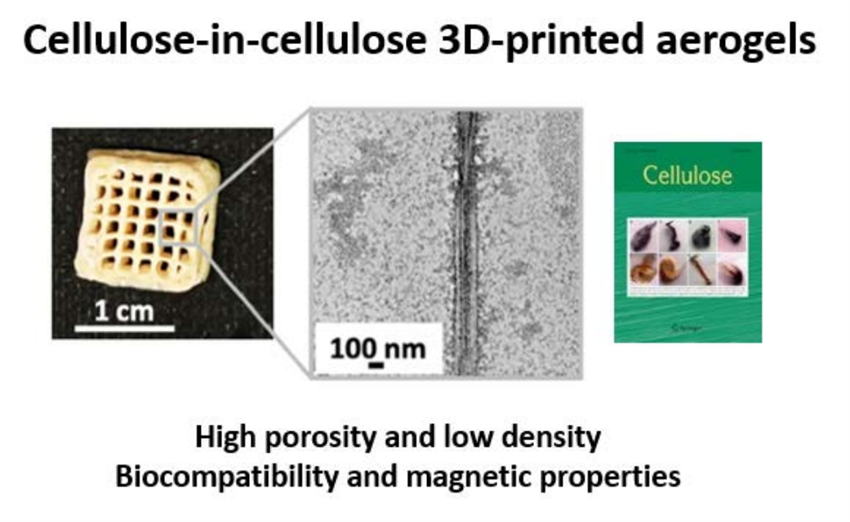
In this work cellulose-in-cellulose 3D-printed aerogels were fabricated by 3D-printing of
methylcellulose-bacterial cellulose nanofibers based inks, and subsequent scCO2 drying and
sterilization of thus obtained scaffolds. Textural characterization was performed by TEM, SEM
and nitrogen adsorcion/ desorcion analysis and biological properties were assessed by cyto-,
hemocompatibility and Artemia salina assays. Magnetic evaluation of nanoparticles
incorporated into scaffolds was also carried out regarding bone tissue engineering applications.
The work entitled “Cellulose-in-cellulose 3D-printed bioaerogels for bone tissue engineering”
has been published in Cellulose journal (I.F. 5.7, December 2023). This work comes from a
collaboration between the University of Santiago de Compostela, the University of Lisbon, and
the University of Barcelona.
Recent Comments