
Dual crosslinked aerogel-based scaffolds for bone pathologies
Bone defects coming from fractures, bone pathologies or tumors can be reconstructed employing bone implants to stimulate spontaneous bone healing processes. A variety of scaffolds have been tested in the orthopedic field to provide bone cells viability, proliferation, and long-term bioactivity. An ideal graft aimed to bone regeneration must fulfill biological and structural requirements as well as sterility ensured at a medical grade.
3D-printing has been broadly employed in bone tissue engineering because it is a fast, precise, automated, and reproducible manufacturing technology. Moreover, the desired shape suitable for specific patients demands can be achieved by this technique, suggesting its promising application for an advanced and personalized treatment. However, 3D-printed scaffolds usually need an improvement in the internal structure control, an important challenge in bone tissue engineering field. Supercritical fluid technology based on the use of supercritical carbon dioxide (scCO2) has demonstrated to preserve the advanced gel properties in the dry state without damaging their textural properties.
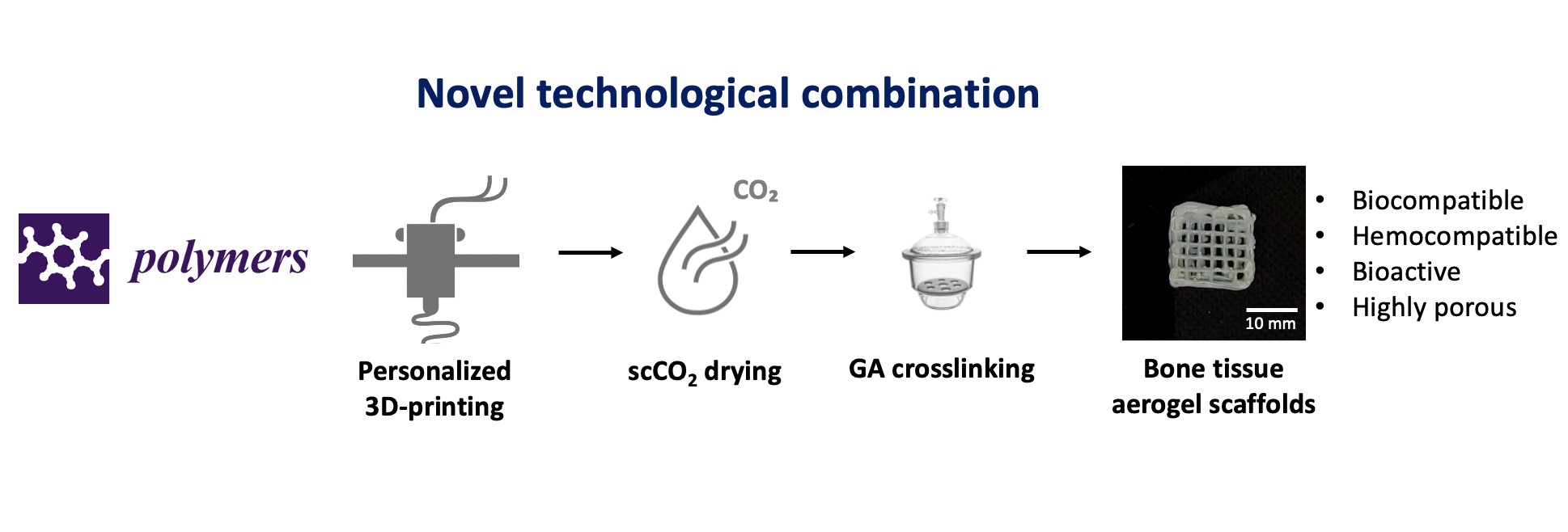
In this work, aerogel-based scaffolds were obtained by 3D-printing of alginate-hydroxyapatite inks, scCO2 drying of the gel-based scaffolds and glutaraldehyde crosslinking of the aerogels. Textural and biological performances of the different formulations were evaluated for bone tissue engineering applications by nitrogen adsorption/ desorption analysis, SEM microscopy, bioactivity tests and by cyto- and hemocompatibility assays.
The work entitled “3D-Printed, Dual Crosslinked and Sterile Aerogel Scaffolds for Bone Tissue Engineering” has been published in Polymers journal (IF: 4.329) on March 2022.
Recent Comments